Can't Take Hormones (or Afraid To)? Your Real Options for Hot Flashes and Night Sweats
Everyone keeps telling you the same thing: "Just take hormones." Your friends swear by them. The podcasts rave about them. But you had breast cancer. Or a blood clot. Or you're on a hormone blocker. Or maybe you just don't feel comfortable with HRT, and you're tired of being made to feel that's not allowed.
Meanwhile, you're waking up drenched, flushing in meetings and running on broken sleep.
When "Rosa" came to me, she had finished breast cancer treatment and was taking a hormone blocker. HRT wasn't an option. She rated her hot flashes and night sweats a 4 out of 4, the most severe, even though she had already tried a prescription. Within a couple of months of working on her food, digestion and evening routine, she was rating them a 1. Rosa's name and details have been changed. Her story is her own experience; individual results vary.
If HRT isn't for you, I want you to hear this clearly: you are not out of options. These are the women I work with most, and there is a lot we can do.
What's really happening during a hot flash
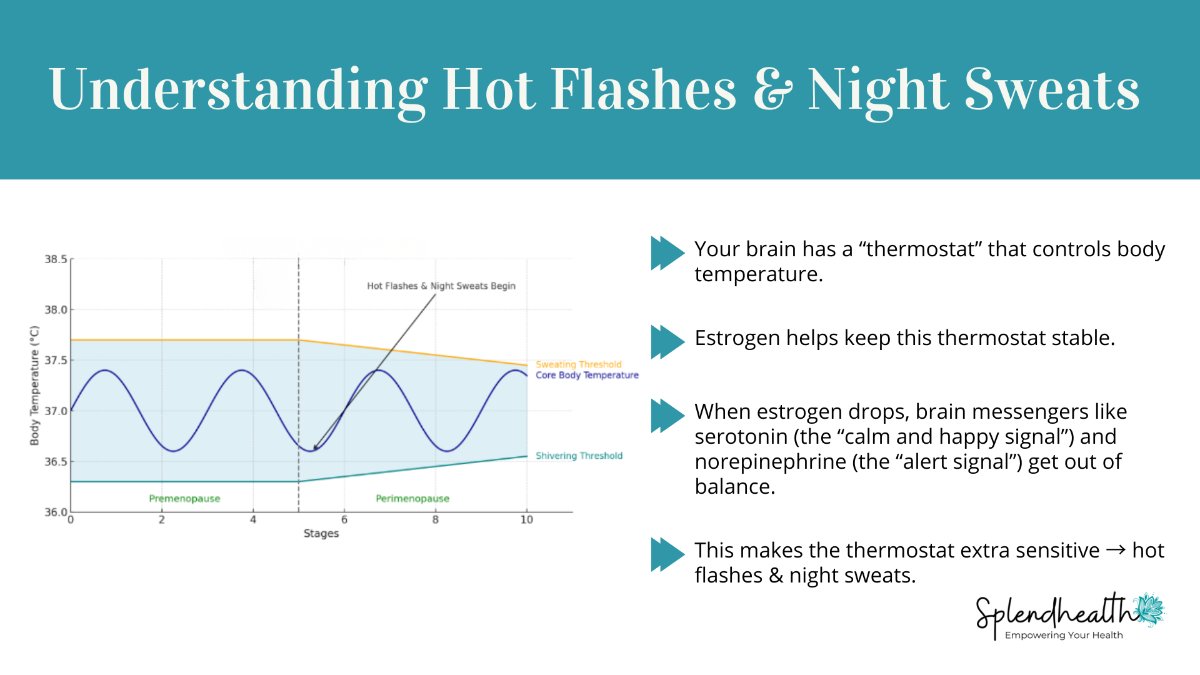
A hot flash doesn't start in your skin. It starts in your brain, in a small area called the hypothalamus, which works like your body's thermostat. Here's the chain reaction:
Estrogen used to keep the thermostat calm. Deep in the hypothalamus, there's a group of brain cells that estrogen keeps quiet. As estrogen drops and swings in perimenopause, these cells become overactive and send out a strong "heat" signal (a messenger called neurokinin B).
Your comfort zone shrinks. Your thermostat normally lets your temperature drift a little before it reacts. Now that range narrows to a sliver, so a tiny rise in body temperature, one you never would have noticed before, sets off the alarm.
Your alarm chemistry joins in. Two brain messengers help run the thermostat: norepinephrine, the "alarm," and serotonin, the "stabilizer." When stress keeps norepinephrine high and serotonin isn't steady, the thermostat gets even jumpier.
Your body tries to dump heat, fast. Blood vessels in your skin open up (the flush), you sweat, and your heart races. Then you cool down too much and get chills.
So a hot flash isn't your body "overheating." It's a thermostat that has become extra sensitive, and things like blood sugar swings, stress, alcohol and poor sleep make it even more reactive.
That's the hopeful part: we can calm many of the things that make the thermostat jumpy, without adding hormones. And remember, menopause isn't only about your ovaries. Your brain, adrenals, thyroid, gut and liver all shape how you go through this transition. I call it menopause beyond the ovaries.
Option 1: Build the foundations that calm the thermostat
This is where we always start, because everything else works better on top of it:
Steady blood sugar. Protein and vegetables at every meal, and no skipping meals. Women with higher insulin levels tend to have more hot flashes that last longer.
Eat enough. Chronic undereating and long fasts put your body in stress mode, and stress makes hot flashes louder.
Support your gut and liver. They clear used hormones out of your body. Fiber, cruciferous vegetables and 2 tablespoons of ground flaxseed a day are great foods for this. (Flax is a food, not a hot flash cure: a large trial didn't find it reduced hot flashes. But it's still one of the best foods for your gut.)
Protect your sleep and evenings. Move the wine earlier or take a break from it, keep the bedroom cool, and wind down without screens.
Option 2: Plant extracts that work at the receptor level
Not all "natural" remedies are equal. Some botanicals have real clinical trials behind them, and some work in a very targeted way.
A special extract of rhapontic rhubarb root is one I use often. Instead of acting like estrogen everywhere in the body, it selectively activates estrogen receptor beta, the type involved in the brain's temperature control. In two placebo-controlled trials in perimenopausal women:
Hot flashes dropped from about 11 a day to 4 in 12 weeks.
Overall menopause symptom scores fell by more than half, compared with very little change on placebo.
The studies didn't show thickening of the uterine lining.
An important note: those trials weren't done in breast cancer survivors. If you've had breast cancer, any botanical (even a gentle one) should be chosen together with your oncologist. Some herbs and supplements can even interfere with breast cancer medications, so I always review everything you take.
Option 3: Calm your brain chemistry
Because the thermostat lives in your brain, your brain chemistry matters. Norepinephrine, your "alarm" chemical, helps control body temperature, and stress keeps it high. In my practice, we support the calming side of your brain chemistry with targeted nutrients, chosen from your symptoms and testing, not from a one-size-fits-all list. This is a functional medicine approach, and it's one of the places where personalization makes the biggest difference.
Option 4: Change how your nervous system responds
This one surprises people. Cognitive behavioral therapy (CBT) for hot flashes has been tested in women after breast cancer. In one trial, women who did group CBT saw how much their hot flashes and night sweats bothered them drop by 46%, compared with 15% in usual care. Their sleep, mood and anxiety improved too. Clinical hypnosis has research behind it as well.
Option 5: Train your thermostat (yes, with exercise)
Here's what nobody tells you: the right kind of exercise doesn't just help your weight. It can retrain the thermostat we talked about above.
When you get fitter, your body gets better at handling heat. Your resting core temperature drops slightly, you start sweating and opening up skin blood vessels a little earlier and more smoothly, and blood flow to your brain stays steadier. In one small study, women who trained for 16 weeks had about 60% fewer hot flashes, while the women who didn't exercise had no change (Bailey, 2016).
Strength training helps too. In a Swedish trial, women who started lifting weights 3 times a week, at a level that felt truly challenging, cut their moderate to severe hot flashes by about 44% in 15 weeks. The women who didn't change anything saw no improvement (Berin, 2019). That's close to what some medications do, and it's an option you can use even if you've had breast cancer (with your oncologist's OK).
But here's the twist for women in midlife: more isn't better. Smarter is better. Exercise physiologist Dr. Stacy Sims points out that the long, moderate workouts many of us grew up with (the hour on the elliptical, the daily slow jog) sit in a zone that's "too hard to be easy and too easy to be hard." As estrogen drops, that zone tends to push cortisol up and leaves you tired but wired, which is exactly what makes the thermostat jumpier.
What works better:
Lift heavy, 2 times a week. Short sessions: a few big moves (squats, deadlifts, presses, rows), about 3 to 5 sets of 3 to 5 reps, with real rest between sets. Heavy enough that the last reps are hard. This is what tells your muscles and bones to stay strong. If you're new, start lighter and get coached on form first.
Short bursts, 1 to 2 times a week. For example, 30 seconds as hard as you can on a bike or rower, then 90 seconds of very easy recovery, repeated a few times. Or jump training (squat jumps, skipping), which your bones love.
Easy days that are truly easy. Walking, mobility, yoga. Your recovery is when your body adapts.
Protect your sleep. Don't trade sleep for a 5 a.m. workout. Poor sleep makes hot flashes worse.
A few hot-flash tips for workout days: train in a cool room or early in the day, dress in layers, keep cold water with you, and if evening workouts trigger night sweats, move them earlier. A workout can bring on a flush in the moment. That's normal, and it isn't a sign it's not working.
And if you've been told you're too tired to exercise, start where you are. Two short strength sessions a week is a real beginning.
Option 6: Non-hormonal prescriptions
If your symptoms are severe, there are prescription medicines that aren't hormones. It helps to know what they are and how they work, so you can have an informed conversation with your doctor:
Low-dose antidepressants (SSRIs and SNRIs). At low doses, they steady the serotonin and norepinephrine that help run the thermostat. One is FDA-approved specifically for hot flashes. Possible side effects include nausea, sleep changes and lower libido. If you take tamoxifen, this matters: some of these medicines interfere with how tamoxifen works, so your oncologist needs to choose.
Gabapentin. A nerve-calming medicine that can reduce hot flashes and is often taken at bedtime, which can help night sweats and sleep. It can cause drowsiness and dizziness.
Oxybutynin. A bladder medicine that also reduces sweating. It can cause dry mouth and constipation, and isn't a good fit for everyone as we age.
Brain-thermostat blockers (NK3 receptor blockers). The newest option. They block the overactive "heat" signal in the hypothalamus that we talked about above. Because they're new, we don't have long-term data yet, and liver tests are needed while taking them.
These medicines can quiet the signal, but they don't change what's making your thermostat jumpy in the first place. That's why, even if you and your doctor decide on a prescription, the foundations above still matter.
What about vaginal dryness?
It's one of the symptoms women talk about least, and one of the easiest to help:
Over-the-counter vaginal moisturizers, for example ones with hyaluronic acid. These are used regularly (a few times a week, not just before sex) to hydrate the tissue. Studies show they can improve dryness and comfort.
Lubricants for intimacy. Water-based or silicone-based, used during sex to reduce friction and pain.
Hormonal options, used locally. Very low-dose vaginal estrogen (cream, tablet or ring) or vaginal DHEA work right where they're needed, with very little absorbed into the rest of the body. If you've had breast cancer, the American College of Obstetricians and Gynecologists says low-dose vaginal estrogen can be considered when non-hormonal options aren't enough, decided together with your oncologist.
What you can do this week
Write down your hot flashes for one week: when, how strong, and what happened before. Then look back and see if there's any pattern: certain foods, wine, stress, a bad night's sleep or a time of day. Patterns tell us where to start.
Add protein to breakfast and don't skip meals.
Add 2 tablespoons of ground flaxseed and a serving of cruciferous vegetables a day for your gut and hormone clearance.
Make a list of everything you take (medications, supplements, herbs) and bring it to your next appointment.
Book one conversation with someone who will look at the whole picture, not just tell you "take hormones" or "there's nothing to do."
How Splendhealth can help
I'm Maria Merlo, a certified Functional Medicine Health Coach in Greenville, SC. Many of my clients are women who can't take hormones, or who don't want to. Together we look at what's driving your symptoms (blood sugar, stress, sleep, gut and how your body clears hormones) and build a plan that fits your history, your medications and your comfort level.
We test instead of guessing, and every program includes a complete lab panel. I work alongside your doctor and oncologist, never instead of them, and I never change your medications. Learn more on our Menopause & Perimenopause page or about the Feel Splendid Again program.
Book your free 30-minute Wellness Clarity Call →
About the author: Maria Merlo is a Certified Functional Medicine Health Coach (AFMC, School of Applied Functional Medicine) and an Institute for Integrative Nutrition graduate. Read her story.
This article is for education only and is not medical advice. It doesn't diagnose, treat or cure any condition. If you have a history of cancer, talk with your oncologist before starting any supplement or herb.
Sources
Heger M et al. Efficacy and safety of a special extract of Rheum rhaponticum (ERr 731) in perimenopausal women with climacteric complaints: a 12-week randomized, double-blind, placebo-controlled trial. Menopause 2006;13:744–759 (summary).
Kaszkin-Bettag M et al. Confirmation of the efficacy of ERr 731 in perimenopausal women with menopausal symptoms. Altern Ther Health Med 2009.
Wober J et al. Activation of estrogen receptor-beta by a special extract of Rheum rhaponticum (ERr 731). J Steroid Biochem Mol Biol 2007.
Wilson M et al. Rheum rhaponticum root extract improves vasomotor menopausal symptoms in an ovariectomized rat model. Int J Mol Sci 2021.
Fenlon D et al. Effectiveness of nurse-led group CBT for hot flushes and night sweats in women with breast cancer: MENOS4. Psycho-Oncology 2020.
Mann E et al. Cognitive behavioural treatment for women who have menopausal symptoms after breast cancer treatment (MENOS 1). Lancet Oncol 2012 (also notes possible interactions between some SSRIs and tamoxifen).
Pruthi S et al. A phase III randomized, placebo-controlled trial of flaxseed for hot flashes (NCCTG N08C7). Menopause 2012.
The North American Menopause Society. 2023 Nonhormone Therapy Position Statement (weight loss, CBT, clinical hypnosis, non-hormonal prescriptions).
Athar F et al. Insulin levels early in perimenopause inform vasomotor symptom incidence. J Clin Endocrinol Metab 2026.
ACOG Committee Opinion No. 659. The use of vaginal estrogen in women with a history of estrogen-dependent breast cancer (2016).
Bailey TG et al. Exercise training reduces the frequency of menopausal hot flushes by improving thermoregulatory control. Menopause 2016.
Berin E et al. Resistance training for hot flushes in postmenopausal women: a randomised controlled trial. Maturitas 2019.