
Exhausted, Anxious and Up at 3 A.M., but Your Periods Are Still Regular? The Perimenopause Signs Nobody Tells You About
You're 41, 44, maybe 47. Your periods still come every month. You don't have hot flashes. But you wake at 3 a.m. with your heart pounding, you snap at people you love, and you're exhausted no matter how much you sleep. Your doctor says your labs are "normal" and suggests it's stress.
It may be stress. It may also be perimenopause in disguise. You're not alone in wondering: in a 2026 study of more than 7,600 U.S. women, one in three wasn't sure whether she was in perimenopause. Among women 40 to 44, it was 42%.
Not sure where you stand? Take my free 3-minute Is It Perimenopause? check and see how closely your symptoms fit perimenopause, and which look-alikes may be in the mix.
Perimenopause, in one line: it's the transition years before your final period ("peri" means "around"), when your ovaries work in fits and starts. It usually begins in your 40s and can last 4 to 10 years. Menopause is one day: 12 months after your last period.
What's really happening: progesterone leaves first
Most women picture perimenopause as "estrogen running out." That's the end of the story, not the beginning.
Reason #1: Progesterone drops first, often years earlier. You make progesterone after you ovulate. In your 40s, ovulation gets less reliable, so progesterone falls well before estrogen does. That matters because progesterone is your calming hormone. Its byproduct, allopregnanolone, works on the same brain receptors (GABA) as anti-anxiety medicines. Less progesterone can mean more anxiety, lighter sleep, and shorter fuses.
Reason #2: Estrogen doesn't fall in a straight line. It zigzags. In early perimenopause, estrogen can swing higher than it was in your 20s, then crash, then spike again. High estrogen with low progesterone looks like heavier periods, sore breasts, bloating and worse PMS. The crashes can bring night sweats, migraines and mood dips.
Reason #3: Your stress system takes on more of the work. As your ovaries step back, your adrenals become a bigger source of hormones. In functional medicine we see perimenopause as a magnifying glass: it turns up whatever was already out of balance. If you were already running on stress, poor sleep or blood sugar swings, this is when it shows. (This is a functional medicine view, taught at the School of Applied Functional Medicine, not a mainstream consensus.)
Here's what that looks like:
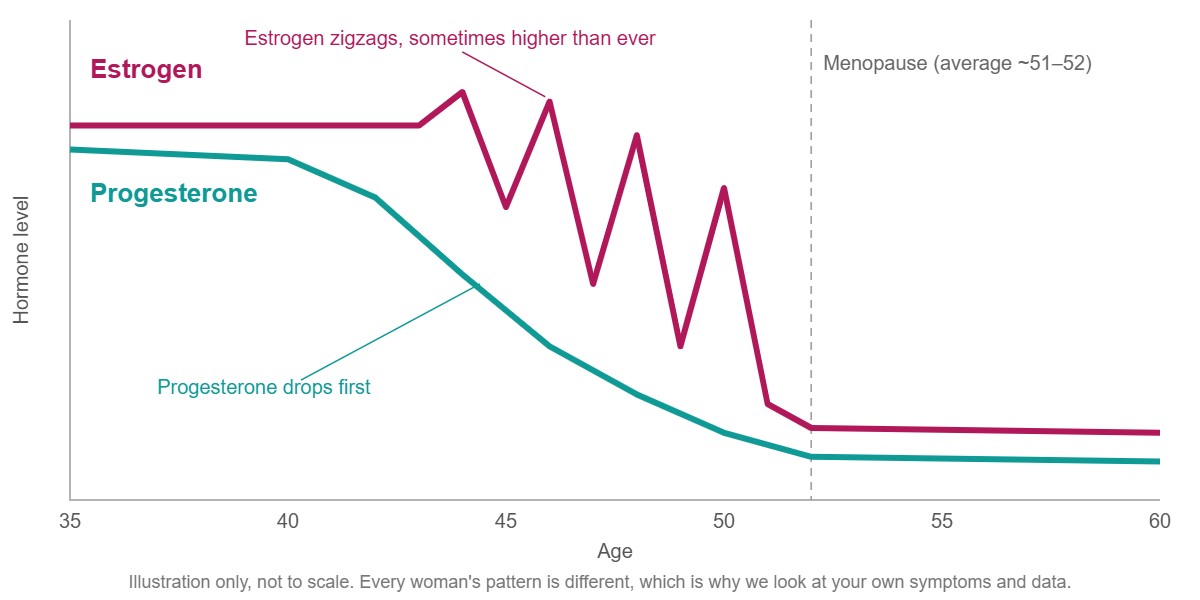
Illustration only, not to scale. Every woman's pattern is different, which is why we look at your own symptoms and data.
8 signs of perimenopause that don't look like perimenopause
What women expect and what they get are different. In a 2026 Mayo Clinic and Flo study, women most often expected hot flashes (71%), sleep problems (68%) and weight gain (65%). But among women who said they were in perimenopause, 95% reported exhaustion and 93% fatigue, far more than reported hot flashes.
Anxiety or rage that doesn't feel like you. Racing thoughts, panic out of nowhere, or a short fuse. Falling progesterone takes away some of your natural calm.
Waking at 3 a.m. You fall asleep fine, then you're wide awake. Lower progesterone, blood sugar dips and a stress-hormone surge can all play a part. (More in Waking Up Drenched at 3 A.M.?)
Exhaustion that sleep doesn't fix. The most common symptom in the study above, and the one most often blamed on "just being busy."
Heavier, closer or more painful periods. "Regular" doesn't rule out perimenopause. You can still bleed every month without ovulating fully. Worse PMS and tender breasts often come with it.
Bloating and a gut that changed. Three in four women in the same study reported digestive issues. Your gut also helps clear used estrogen, so constipation can keep estrogen recirculating. (Gut health)
Brain fog. Losing words, walking into a room and forgetting why.
Weight moving to your middle on the same habits. In the SWAN study, the rate of fat gain doubled at the start of the menopause transition, while lean muscle declined. (More in Why Am I Gaining Weight in Perimenopause?)
The odd ones. Achy joints or a stiff shoulder, heart palpitations, itchy skin, new migraines around your period.
It can start earlier than you think. In a U.S. survey of 4,432 women, many women aged 30 to 45 already had perimenopause-related symptoms. And Black and Hispanic women reach menopause about two years earlier on average and tend to have symptoms longer.
Or is it something else? The look-alikes
Here's where perimenopause really hides: several other common problems feel almost the same. Often it's perimenopause plus one of these, which is why guessing doesn't work.
Look-alike | Can feel like | Ask about |
|---|---|---|
Thyroid, including Hashimoto's | Tired, cold, weight gain, hair loss, low mood, heavy periods | A full thyroid panel, including TPO antibodies (why "normal" TSH isn't the whole story) |
Low iron (often from heavy periods) | Exhausted, out of breath, hair shedding, restless legs | Ferritin and a CBC |
Blood sugar and insulin | 3 a.m. waking, cravings, belly weight, afternoon crashes | Fasting glucose, fasting insulin, HbA1c |
Stress overload | "Wired but tired," anxiety, poor sleep | How your cortisol moves through the day (in functional medicine, a DUTCH test can show this) |
Low vitamin D or B12 | Fatigue, low mood, aches; with B12, also tingling and brain fog | Vitamin D and B12 levels |
Pregnancy | A late or missed period | Yes, it's still possible in perimenopause. Take a test. |
See your doctor promptly if you have bleeding so heavy you soak a pad or tampon every hour for several hours, bleeding between periods or after sex, any bleeding after 12 months without a period, chest pain or fainting with palpitations, or a new, severe headache. If you have thoughts of harming yourself, call or text 988.
Why your labs can say "normal"
One blood draw is a snapshot of a moving target. FSH and estrogen swing so much in these years that UK guidelines advise diagnosing perimenopause from symptoms alone in healthy women over 45, not from an FSH test.
That's why I start with your story: your symptoms, your cycle and your timeline. When testing helps, I look at patterns, not one number. A DUTCH test, for example, shows how you break down estrogen, how much progesterone you make, and your cortisol rhythm across the day. No test tells the whole story, so results always get read alongside how you feel.
What you can do this week
Track two cycles. Note your cycle day, sleep, mood, energy and bloating. Patterns jump out fast, and they're gold for any appointment.
Eat protein within an hour of waking. Aim for about 30 grams (eggs, Greek yogurt, a protein smoothie). A steadier morning blood sugar means fewer crashes and cravings later.
Move caffeine before noon and try two weeks without alcohol. Alcohol raises estrogen production, adds to your liver's workload and raises cortisol, a triple hit on sleep in these years.
Lift something heavy two or three times a week. Muscle is your metabolism's best friend now, and it protects your bones.
Keep things moving. Fiber and a daily serving of broccoli, cabbage or arugula, plus enough water, help your body clear the estrogen it's done with. Aim for a bowel movement every day.
How Splendhealth helps
You're not too young, and you're not imagining it. You also don't have to guess.
In my 90-day Feel Splendid Again program, we connect your symptoms to what's driving them: hormones, thyroid, gut, blood sugar and stress. Every program includes a full thyroid panel. For perimenopause, the Private path adds a DUTCH hormone test. Whether you want hormone therapy, can't take it, or are afraid to, you have options. (Your real options for hot flashes without hormones)
Start here: take my free 3-minute Is It Perimenopause? check. You'll see right away how closely your answers fit perimenopause and the common look-alikes (thyroid, iron, blood sugar, gut and stress).
Then, if you want a plan, book a free 30-minute Wellness Clarity Call. Read more on the menopause page.
About the author: Maria Merlo is a Functional Medicine Health Coach and founder of Splendhealth in Greenville, SC. She trained at the School of Applied Functional Medicine and the Institute for Integrative Nutrition, and helps women over 35 with hormone, thyroid and gut concerns. About Maria
This article is for education only. It is not medical advice and does not diagnose or treat any condition. Talk with your healthcare provider about your symptoms, tests and treatment.
Sources
Xu Y et al. Perimenopause uncertainty among US women (7,600+ women). Menopause, 2026. Menopause Society release
Mayo Clinic and Flo. Perimenopause symptom knowledge and experience (17,494 people). Menopause, 2026. Mayo Clinic News Network
Cunningham AC et al. Perimenopause symptoms, severity, and healthcare seeking in women in the US. npj Women's Health, 2025. doi:10.1038/s44294-025-00061-3
Greendale GA et al. Changes in body composition and weight during the menopause transition (SWAN). JCI Insight, 2019. Article
Prior JC. Perimenopause: The ovary's frustrating grand finale. CeMCOR, University of British Columbia. Article
NICE guideline NG23, Menopause: diagnosis and management. Implementation: FSH testing
AARP. Menopausia y perimenopausia en mujeres negras e hispanas, 2026. Article
School of Applied Functional Medicine. Hormones Demystified course (Key Interconnectedness Pearls 2, 5, 6, 13, 18 and 20).
Cover photo: engin akyurt on Unsplash.